Product Overview
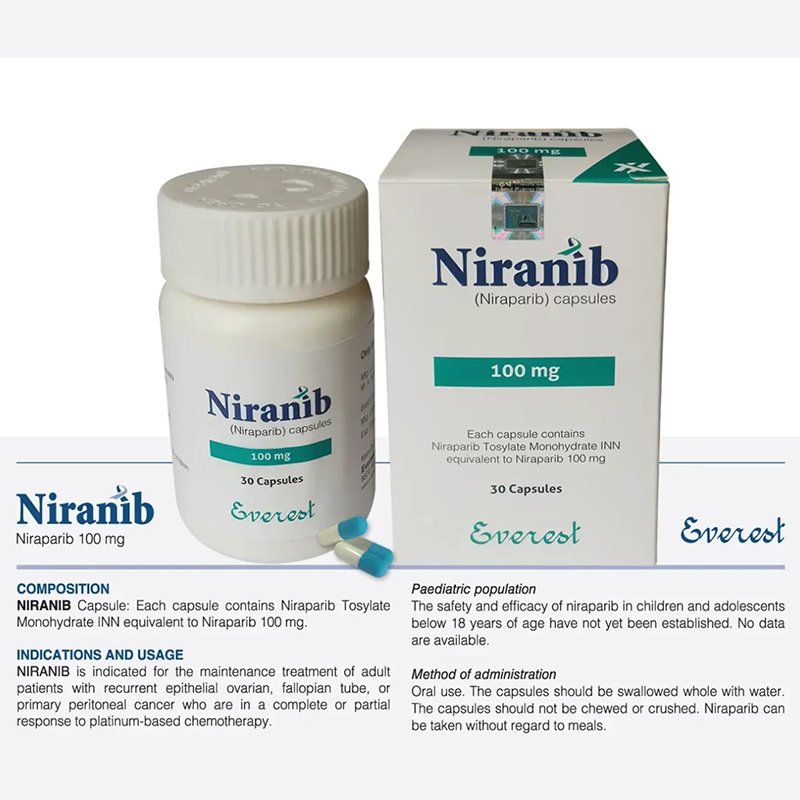
Niraparib (also known as Niraparib; Brand name: Zejula) manufactured by Everest Pharma is a poly (ADP-ribose) polymerase (PARP) inhibitor targeting PARP-1 and PARP-2 enzymes. It is primarily used as maintenance therapy for advanced recurrent ovarian cancer, helping significantly prolong progression-free survival and reduce recurrence risk.
Niraparib received FDA approval in the United States in March 2017 and was later approved in Europe in November 2017 for maintenance treatment of recurrent epithelial ovarian cancer, fallopian tube cancer, or primary peritoneal cancer in patients who achieved complete or partial response after platinum-based chemotherapy. Based on these approvals, Zejula (Niraparib) was approved in Hong Kong in October 2018.
🧬 PARP Inhibitors and Ovarian Cancer Treatment
PARP inhibitors represent a major breakthrough in precision medicine for ovarian cancer. Currently, three PARP inhibitors have been approved globally for ovarian cancer treatment:
- Niraparib
- Olaparib
- Rucaparib
Niraparib became the first PARP inhibitor approved in the United States for maintenance therapy regardless of BRCA mutation status.
📊 Clinical Study Results
Clinical studies demonstrated significant benefits of Niraparib maintenance therapy during the “chemotherapy-free interval” compared with placebo.
1. gBRCA Mutation-Negative Patients
- 55% reduction in disease progression risk
- Progression-free survival (PFS) more than doubled:
2. gBRCA Mutation-Positive Patients
- 73% reduction in disease progression risk
- PFS nearly quadrupled:
These results suggest BRCA mutation status may predict stronger benefit from Niraparib therapy.
3. HRD-Positive but gBRCA-Negative Patients
- 70% reduction in disease progression risk
- PFS extended more than threefold:
- 12.9 months vs 3.8 months
💡 Advantages of Niraparib
1. Pharmacokinetic Advantages
Compared with other PARP inhibitors:
- High bioavailability (~73%)
- Long half-life (~36 hours)
- Higher tumor tissue exposure
- Less need for dose adjustments with other medications due to its unique metabolism
2. Convenient Once-Daily Dosing
- Niraparib is taken once daily, improving patient convenience and adherence
- Olaparib and Rucaparib generally require 2–3 daily doses
3. No Mandatory BRCA Testing
Patients may benefit regardless of BRCA mutation status.
4. Individualized Dosing Improves Safety
The PRIMA study showed that patients weighing less than 77 kg who started with 200 mg once daily experienced reduced hematologic toxicity without compromising efficacy.
Personalized dosing based on body weight and platelet count may reduce treatment-related adverse events.
🌍 Ovarian Cancer Background
In 2018, more than 300,000 women worldwide were diagnosed with ovarian cancer, including over 50,000 new cases annually in China.
Ovarian cancer is difficult to detect early because symptoms are often absent in the early stages. Most patients are diagnosed at advanced stages when metastasis has already occurred, making treatment more challenging.
Before PARP inhibitors became available, maintenance treatment relied mainly on chemotherapy with limited effectiveness. Niraparib and other PARP inhibitors have significantly improved progression-free survival and reduced recurrence rates, transforming ovarian cancer treatment after decades of limited advancement.
📌 Indications
Niraparib is indicated for maintenance treatment of adult patients with:
- Recurrent epithelial ovarian cancer
- Fallopian tube cancer
- Primary peritoneal cancer
who are in complete or partial response to platinum-based chemotherapy.
💊 Dosage and Administration
- Recommended dosage: 300 mg (3 capsules) orally once daily, with or without food
- Continue treatment until disease progression or unacceptable toxicity occurs
- For adverse reactions, consider treatment interruption, dose reduction, or discontinuation
⚠️ Common Side Effects
Common adverse reactions may include:
- Nausea (74%)
- Thrombocytopenia (61%)
- Fatigue/asthenia (57%)
- Anemia (50%)
- Constipation (40%)
- Vomiting (34%)
- Abdominal pain/bloating (33%)
- Neutropenia (30%)
- Insomnia (27%)
- Headache (26%)
- Decreased appetite (25%)
- Nasopharyngitis (23%)
- Rash (21%)
- Hypertension (20%)
- Dyspnea (20%)
- Diarrhea (20%)
- Stomatitis/mucositis (20%)
⚠️ Use in Special Populations
Breastfeeding
Women are advised not to breastfeed during treatment and for 1 month after the final dose of Niraparib.



Reviews
There are no reviews yet.