Description
Product introduction:
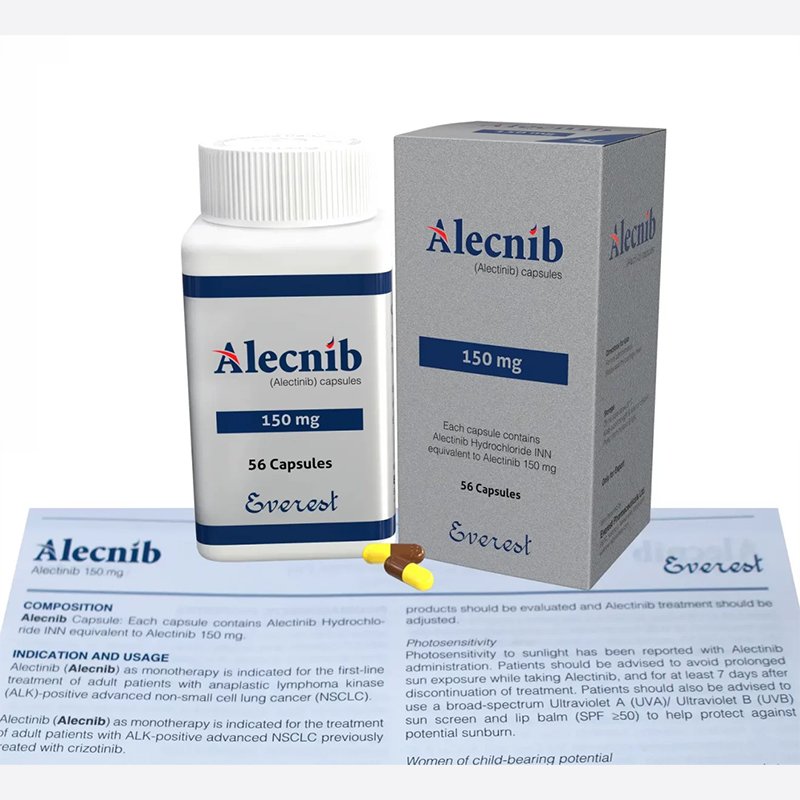
Alectinib (also translated as Ailetinib or Alectinib; brand name: Alecensa/Anshengsha), produced by Everest, is a second-generation ALK inhibitor developed by Roche.
Alectinib was first approved by the U.S. FDA in December 2015 for the treatment of non-small cell lung cancer (NSCLC) patients who had developed resistance to crizotinib. In November 2017, it was further approved as a first-line treatment for advanced ALK-positive NSCLC.
In August 2018, Alectinib was launched in China for first-line treatment of advanced ALK-positive NSCLC. According to official data released by Roche, progression-free survival (PFS) with Alectinib can reach up to 34.8 months, significantly exceeding that of existing standard therapies. Notably, in terms of PFS, first-line Alectinib (34.8 months) not only outperforms first-line crizotinib (10.9 months), but also exceeds the sequential strategy of crizotinib followed by Alectinib after resistance (approximately 20 months).
Even in patients with brain metastases, first-line Alectinib still achieves a PFS of 27.7 months, compared with 7.4 months in the control group, representing a revolutionary improvement.
Currently, four ALK inhibitors have been approved worldwide: crizotinib, ceritinib, alectinib, and brigatinib. Among them, first-line Alectinib shows the longest PFS (34.8 months) and the best overall efficacy. However, in second-line treatment after crizotinib resistance, brigatinib demonstrates superior performance compared to Alectinib and ceritinib, with second-line PFS results of 15.6 months for brigatinib, 8.9 months for Alectinib, and 7.2 months for ceritinib.
Indications:
Monotherapy for the treatment of patients with anaplastic lymphoma kinase (ALK)-positive locally advanced or metastatic non-small cell lung cancer (NSCLC).
Dosage and administration:
The recommended dose is 600 mg (four 150 mg capsules) taken orally twice daily (total daily dose: 1200 mg).
It should be taken with food. Capsules should be swallowed whole and not opened or dissolved.
Before treatment, ALK-positive status must be confirmed using a validated testing method.
Common adverse reactions:
Include constipation (36%), edema (34%, including peripheral edema, generalized edema, eyelid edema, and periorbital edema), myalgia (31%, including muscle pain and musculoskeletal pain), nausea (22%), increased bilirubin (21%, including elevated blood bilirubin, hyperbilirubinemia, and increased conjugated bilirubin), anemia (20%, including decreased hemoglobin), and rash (20%, including rash, maculopapular rash, acneiform dermatitis, erythema, generalized rash, papular rash, pruritic rash, and macular rash).



Reviews
There are no reviews yet.